
Residential solar storage
Validate the duty cycle, site, interfaces, and operating objective before confirming model suitability.
Response target: within 12 hours for project inquiries
solar storage
Two 51.2 V floor-standing LFP battery modules with 200 Ah and 314 Ah capacities, a 4.3-inch touchscreen and CAN/RS485 communications.
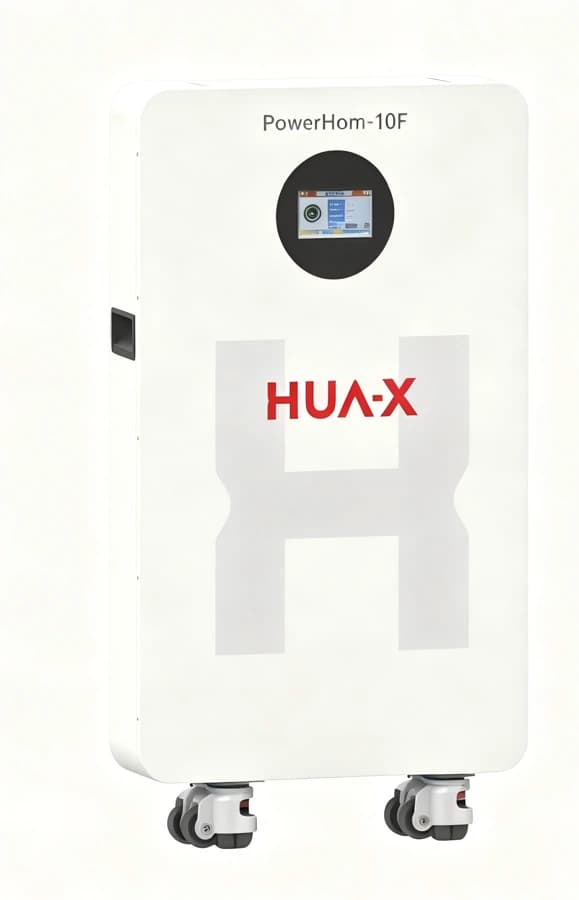
Choose between the 200 Ah PowerHom-10F and 314 Ah PowerHom-16F by required battery energy, current and installation space. These battery modules connect to a separately specified compatible inverter for AC loads.
| Parameter | Value | Condition or note |
|---|---|---|
| PowerHom-10F capacity / energy | 51.2 V / 200 Ah / 10.24 kWh nominal | Energy calculated from nominal voltage × capacity. |
| PowerHom-16F capacity / energy | 51.2 V / 314 Ah / approximately 16.08 kWh nominal | Energy calculated from nominal voltage × capacity and rounded; usable energy depends on the operating window. |
| PowerHom-10F charge / maximum discharge | 80 A / 100 A | — |
| PowerHom-16F charge / maximum discharge | 157 A / 200 A | — |
| PowerHom-10F dimensions / mass | 880 × 530 × 145 mm / 93.5 kg | Height × width × depth. |
| PowerHom-16F dimensions / mass | 820 × 440 × 246 mm / 122 kg | Height × width × depth. |
| Power terminals | M6 on PowerHom-10F; M8 on PowerHom-16F | — |
| Battery chemistry / configuration | LFP / 16 cells in series | — |
| Display | 4.3-inch touchscreen | — |
| Communications | CAN / RS485, Bluetooth and Wi-Fi | — |
Validate the duty cycle, site, interfaces, and operating objective before confirming model suitability.
Validate the duty cycle, site, interfaces, and operating objective before confirming model suitability.
The product rating does not define a turnkey project scope. The quotation should identify who supplies, integrates, installs, commissions, and accepts each applicable item.
Use the public page and any available procurement brief for initial comparison. Request the applicable controlled data sheet, drawings, test or certificate evidence, and commercial documents for the exact quoted model and destination.
Size a home battery from the loads that must run, their coincident and starting power, required backup hours, usable-energy assumptions, recharge opportunity, and the inverter's supported battery configuration.
Read guide →Rack, stacked, and wall-mounted batteries mainly differ in mechanical format, expansion method, service access, footprint, cable routing, and integration. Energy needs and inverter compatibility remain the first filters.
Read guide →Frequently asked questions
Answers cover the information needed to confirm configuration, operating conditions, documentation, price, and delivery.
Technical questions and quotation enquiries for this model.