
Application / Motive power

Warehouse & Material-Handling Power

Forklift battery projects require truck-level compatibility and a shift-by-shift energy and charging plan before chemistry or capacity is selected.
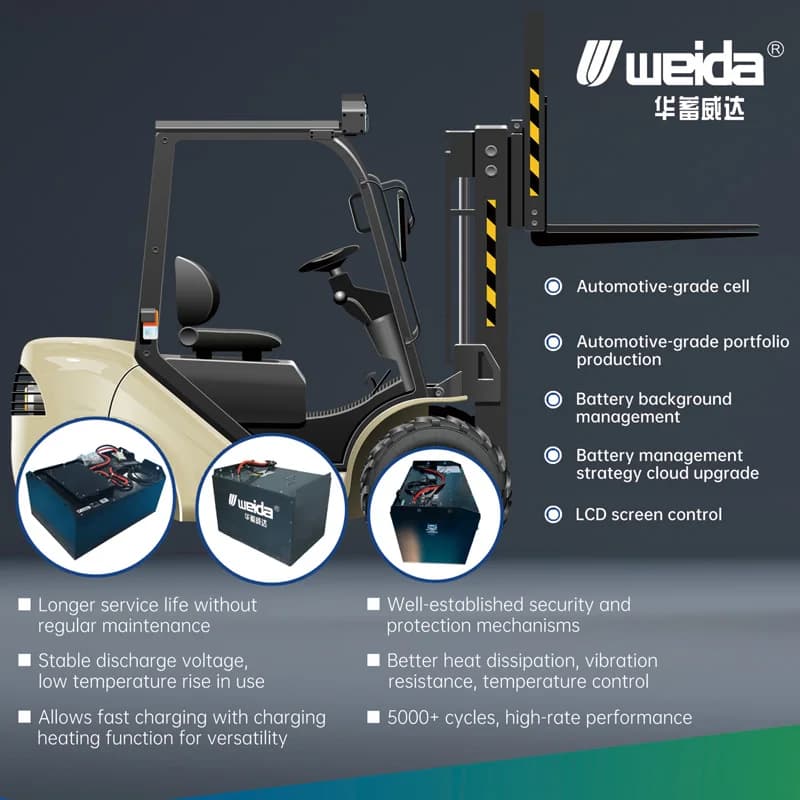
Material-handling vehicle operating in a warehouse

What the material-handling power solution must accomplish

Forklift battery projects require truck-level compatibility and a shift-by-shift energy and charging plan before chemistry or capacity is selected.

A motive battery is part of the truck's weight, electrical, communications, and thermal system. Compartment, counterweight, connector, controller, charger, shift duty, break opportunities, and site temperature all constrain a safe conversion.

Recommended system-design approach

Build a truck inventory and duty profile, record existing battery and charger data, then define energy per shift and available charging windows. Validate physical fit, weight, current, connectors, communications, thermal behavior, and charger coordination at model level.

  • Truck make, model, compartment dimensions, minimum battery weight, and center of gravity
  • Nominal voltage, peak and continuous current, connector, cable, and communications
  • Energy per shift, number of shifts, opportunity charging, and charger capacity
  • Ambient temperature, washdown or dust exposure, vibration, and service access
  • Fleet rollout, operator training, charging-area design, and maintenance responsibility

How to prepare a technical brief

A useful technical brief describes the operating problem before naming a product. Follow the steps below so the proposal can be sized against real loads, constraints, and operating priorities.

  • Create a truck-by-truck compatibility table.
  • Measure the shift energy and record charging opportunities.
  • Validate weight, fitment, connector, current, charger, and communications.
  • Pilot the exact truck and battery configuration before fleet rollout.

Technical reading

Use the supporting selection guides

selection guide

LiFePO4 vs VRLA

Choose LiFePO4 or VRLA from the duty cycle, power, usable energy, charging, temperature, weight, space, maintenance, system integration, replacement plan, and total project cost—not a chemistry slogan.

Read guide →
buyer guide

BESS RFQ Checklist

A useful BESS RFQ states the operating objective, site data, power, usable energy, duration, electrical interface, environment, safety requirements, scope split, documents, and acceptance criteria.

Read guide →

Frequently asked questions

What buyers ask before specifying a battery system

What should I include in a request for quotation?
Include the application, target voltage, power, usable energy, expected duty cycle, available installation space, destination country, and any project-specific compliance requirements. If values are not yet known, submit the load data and ask for technical selection support.
Which certifications are available?
Certification scope varies by model and destination. Request the current certificate and test-report package for the exact quoted model; legacy or expired certificates are not presented as current product credentials.
What warranty applies to the products?
Warranty terms are model- and contract-specific. Ask for the written warranty supplied with the exact quotation; design life, cycle data, and warranty are different concepts and must not be treated as interchangeable.
What is the production and delivery lead time?
Lead time is confirmed only after the configuration, quantity, compliance documents, packaging, and destination are known. No fixed lead-time promise is made on this website because these inputs materially change the schedule.

Discuss a material-handling power project

Send real load and site inputs. The application context will stay attached to the inquiry.