
HUA-X battery project reference / Inland Queensland, Australia
Auxiliary Lithium Storage Supports Overnight Stops for a Queensland Road Train
A Queensland road-train operator installed 14.34 kWh of auxiliary battery storage for cab appliances on long remote journeys, with 22% charge remaining after a nine-hour overnight operating test.
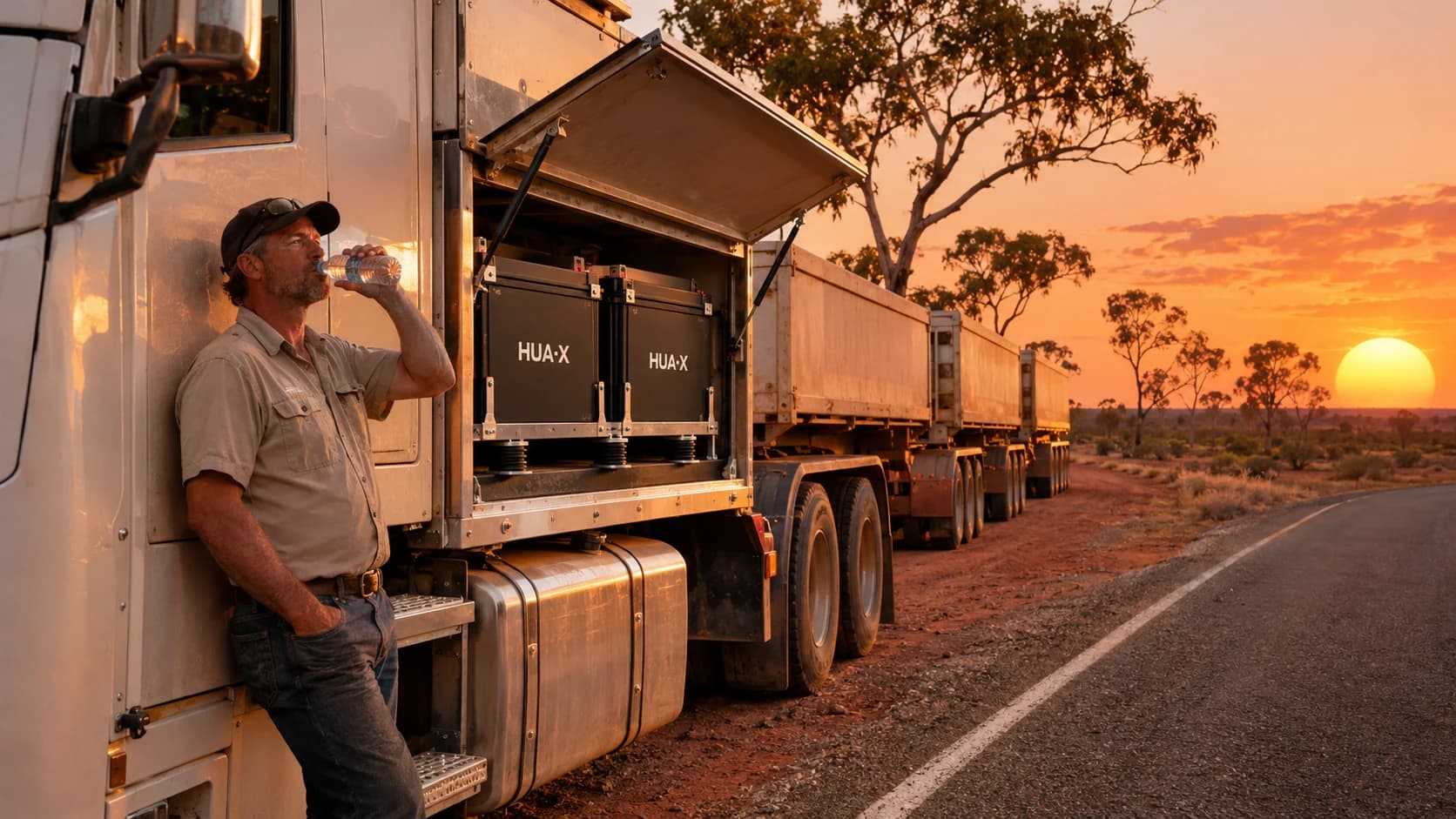
A rest stop far from external power
A road-train operator in inland Queensland made journeys of approximately 1,800 km with only two fuel stops along the route. Overnight rests often took place at the roadside, where cab cooling, refrigeration and other appliances depended on the vehicle's own energy supply.
The former four-battery AGM arrangement provided less than five hours of support in the customer's duty. The replacement needed longer auxiliary duration and an installation suited to rough roads.
Storage and mounting designed for the route
The truck received two 24 V-class, 280 Ah lithium groups, specified at 7.17 kWh each and 14.34 kWh combined. The installation included internal reinforcement, rubber vibration mounts, a shading panel and ventilation around the battery compartment.
The operating environment reached 46°C, and the route included corrugated road surfaces. After 80,000 km, inspection found no loosened cell connection strips.
Overnight support
The nine-hour overnight operating test included cab air conditioning, a refrigerator and microwave use, with 22% charge remaining at the end. The two battery groups cost A$3,040, at A$1,520 each.
The result gave the driver a longer period of cab services without restarting the engine for auxiliary power. Mechanical installation and the actual pattern of appliance use were integral to that outcome.
Project FAQ
Questions about this project reference
Configuration, application and operating conditions for this project.
Did the nine-hour test run the microwave continuously?
Why were mechanical mounting and shade part of the battery project?
Plan a similar battery project
Discuss auxiliary storage for remote long-haul routes
Share the application, destination, operating requirements, quantity and schedule to discuss a configuration for your project.
Response target: within 12 hours. Supply scope, documents, lead time and warranty are confirmed with the quotation.