
HUA-X battery project reference / Mauerpark market, Berlin, Germany
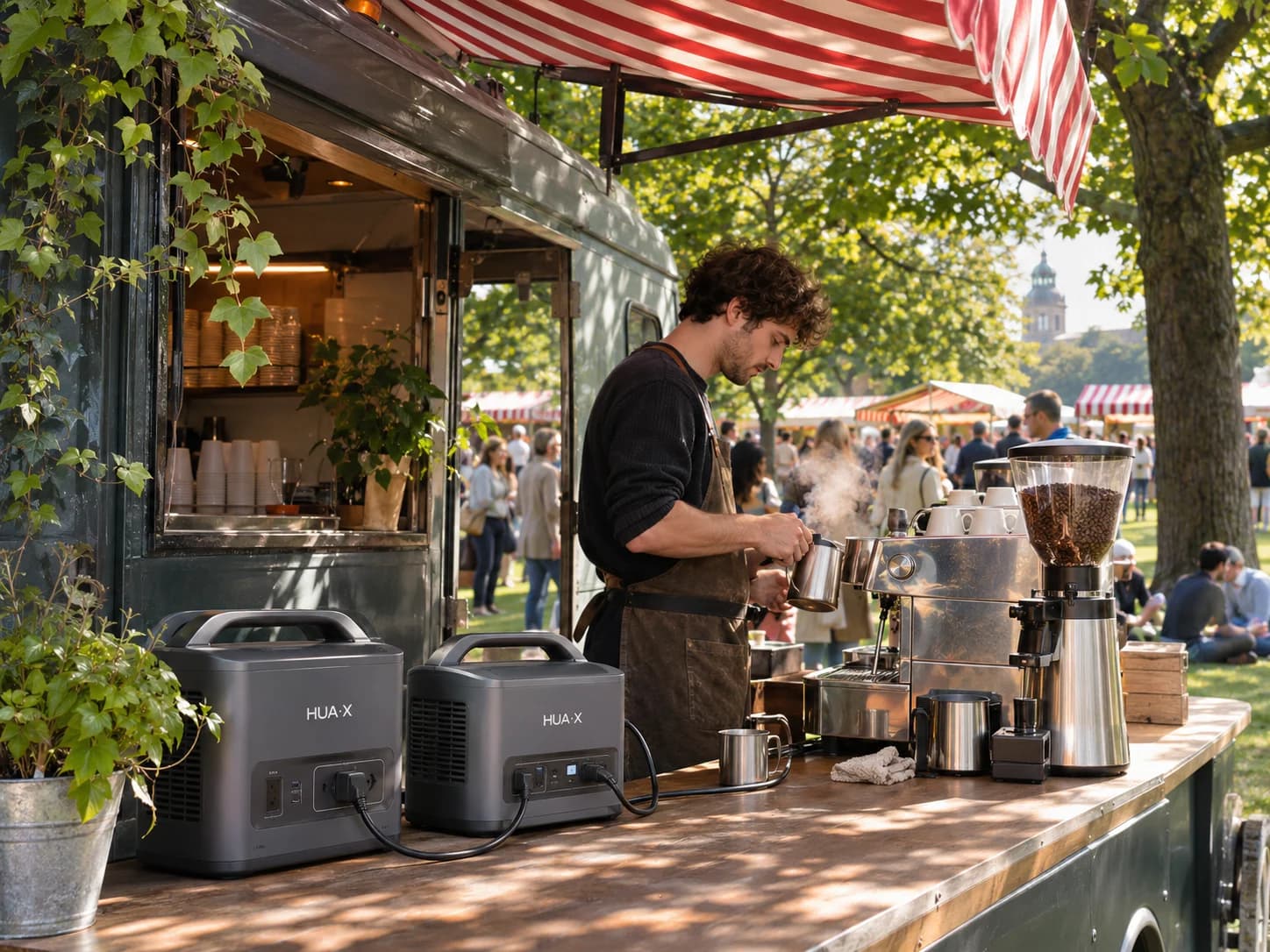
Two Portable Batteries Power a Berlin Market Coffee Cart
A Berlin market vendor used two 2 kWh portable units to supply its coffee equipment, recording 3.6 kWh of consumption over a seven-hour trading day.
Generator noise became a trading constraint
A coffee-cart operator at a Berlin weekend market served around 180 cups a day. The former petrol generators had attracted repeated noise complaints, and the market required the vendor to change the power arrangement.
The equipment included a 1,450 W coffee machine, a 350 W grinder and a 120 W refrigerator. The project needed to serve those appliances through a normal trading day while reducing noise at the stall.
Loads divided between two battery units
The vendor purchased two portable units, each rated at 2 kWh and 2,000 W. One supplied the coffee machine; the other supplied the grinder and refrigerator. The two units therefore provided 4 kWh of aggregate stored energy while serving separate load groups.
The measured seven-hour trading day consumed 3.6 kWh. The customer recharged the units after returning to storage, using the lower-price electricity period.
A lower daily energy cost
The recorded charging cost was €1.10 per trading day, compared with €9.40 for generator fuel. Over ninety trading days a year, the saving was approximately €750. The two units cost €1,580 in total.
The coffee cart’s appliances operated at different times during service, so their combined nameplate power did not describe energy use across the full day. The measured daily energy use and the division of loads were central to making the battery arrangement useful.
Project FAQ
Questions about this project reference
Configuration, application and operating conditions for this project.
Were the two portable units connected together to provide 4,000 W?
How did 4 kWh of stored energy support a seven-hour trading day?
Plan a similar battery project
Discuss battery power for a market stall or mobile business
Share the application, destination, operating requirements, quantity and schedule to discuss a configuration for your project.
Response target: within 12 hours. Supply scope, documents, lead time and warranty are confirmed with the quotation.